Hullo!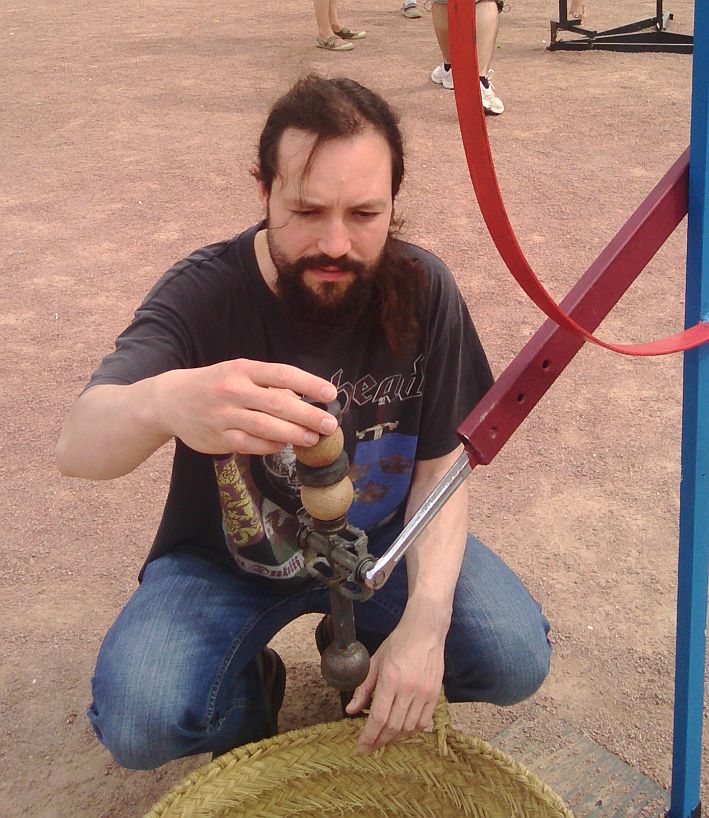
You've found, one way or another, my academic homepage, on which are described my various endeavours in the world of medieval history. Here you can find out what I've done, what I'm doing, and some of what else is out there.
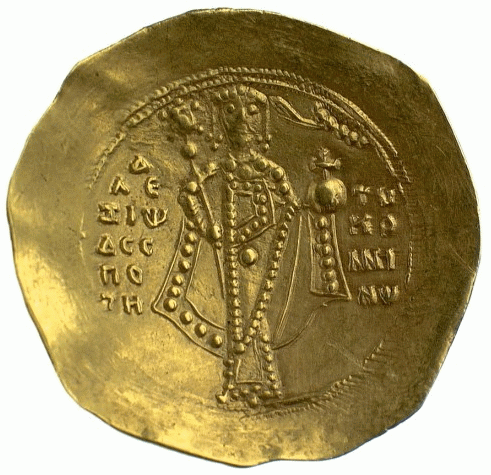 I've been a student of early medieval history (that is, before c. 1100) since the first year of my undergraduate degree. It's now a number of years later, I have that, a Masters, a doctorate and I still haven't had enough. Thankfully, the University of Leeds have seen fit to give me employment, and these days I am their Associate Professor of Early Medieval History. I came there via many years working in Cambridge, on coins and medals for a living and on medieval power relations for fun, via some time in the excellent company of the Queen's College, Oxford and a short while teaching at in the University of Birmingham, after which the coins claimed me back for a year at the Barber Institute of Fine Arts as Interim Curator of Coins, whence I came to Leeds.
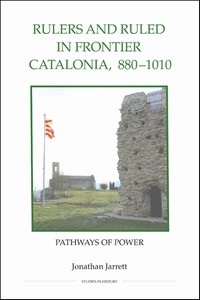
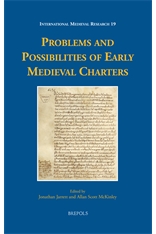
 As I've been caught saying before now, coins are a fairly amazing source for the historian, being encoded but dated documents that fairly ordinary people still handled and used, but I still like also to work on more conventional documents, even if I still focus on those that might have been used by 'the middling sort of person', in an effort to find out how they dealt with the people above and below them. Although my personal interests are in early medieval history, particularly as found in charters or in Spain (especially Catalonia) and ideally both, I've taught a far wider spread, particularly British history of the pre-Norman period, and have also done all right out of being able to work databases and code web-pages (current evidence not withstanding...). Despite the odd bit of electronic savvy, though, I remain firmly wedded to the early Middle Ages for a vocation, and have a small rook of publications about them to my credit, including a monograph, which you can, if you want buy here or here and a volume of essays I edited with Allan Scott McKinley that the rich can buy in whole here or in parts here.
 Part of the reason for this persistence will be the interest I have, and think anyone can share, in the period, its events and people. I'm not going to make huge claims about its modern-day relevance. That's because firstly when history is put to serve modern purposes it usually seems to be misused, so those of us who are hooked on trying to close in on what really happened probably don't want to end up doing that. The second reason is that, ultimately, the average person can lead a full, busy and fulfilling life without ever knowing, for example, whether King Arthur really existed, what the Vikings actually did, how King Harold really died at Hastings, why people went on Crusade, how many masters a Reconquista man might serve or simply what there was to eat for dinner when you were a peasant (which all depends when you were a peasant of course). That doesn't mean that knowing these things, or, where they're not known, trying to find them out, isn't fun. The question is really one of whether you're interested in people or not.
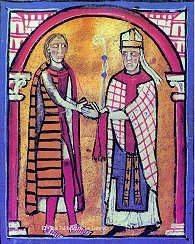 If you are, I can assure you that the Middle Ages was full of them, and what I do is how you go about meeting them, as far as we still can. Some of them did grand things, changed their world and started legends; some of them did nothing that lasted more than a few years. About a few of them we are told a number of outright contradictory things; about most, nothing but what we can deduce from stray sources talking about other things. Answers may have to come from archives,
  manuscripts, rescue excavations, pollen analysis, standing stones, graffiti or even folk tradition, and of course coins! All that means, though, is that the researcher will never run out of worlds to conquer.
If I've piqued your interest, feel free to browse the links at the left. Some are intended for students, and some for researchers; the CV is a more professional account of the career I've just described. Meanwhile I hope that whatever you're doing is as much fun as what I am!
If this seems to be out-of-date, by the way, although I hope to avoid that, I can also be found on Academia.edu and I run a sporadic but rewardingly well-regarded blog on Wordpress, both of which may be more up to the minute. If you're determined to reach me here, my e-mail address is tucked away in the left-hand sidebar, but it is defensive about spam. My institutional address, which comprises my first initial, a dot, my surname in lower case and then @leeds.ac.uk, will likely respond better.